“How often will a small-sized medical subspecialty, like Radiation Oncology have the opportunity to lead a transformational change of global importance?
– Norman Coleman, MD at ASTRO 2020
This year, we have been experiencing major changes in how we go about our day-to-day lives. From drastically reduced face-to-face human interactions, working from home, face masks becoming a fashion statement, and how we make a run for it at a mere sneeze or cough from a nearby human! The new normal still feels so alien to me.
I wouldn’t have imagined, that I would be participating in this year’s world renowned Radiation Oncology conference behind a computer screen from the comfort of home. No jetlag, unlimited video playbacks (in case I couldn’t catch what the presenter said), no need for formal wear, no need for squinting at the presentation slides, and most importantly – no need for running across the GIGANTIC convention center just to get from one good talk to another! At ASTRO in Chicago last year, my FitBit tracker nearly wore itself out counting the more than 15,000 steps I took in a day just getting around the convention floors!


That being said, I do miss the human interaction. I miss bumping into familiar faces during the occasional coffee run, mapping out the “MUST SEE TALKS” with colleagues in the field, or simply networking and meeting new people from all around the world. The virtual format has its perks – but it is just not the same for a social creature like myself.
Despite the unconventional method of attendance, this year’s ASTRO 2020 was special. Well, at least to me, and for a very specific reason. At one of the special sessions, the organizing committee had arranged for Mitch Albom (Yes, the New York Times best-selling and award-winning author MITCH ALBOM ) to share his thoughts on access to cancer care and his experience in fighting for such resources for a young orphan named Chika. His presentation was touching to the point of bringing tears to my eyes, not unlike his wonderfully written books.
(A short summary of his book, Finding Chika is summarized below)

A short summary adapted from the book by Mitch Albom,
Finding Chika:-

Chika Jeune was born 3 days before the devastating
earthquake that decimated Haiti in 2010.
After her mother's tragic death,
she was brought to the Have Faith Haiti Orphanage
run by Mitch and his wife, Janine.

However, at five years old,
Chika was suddenly diagnosed with Diffuse Intrinsic Pontine Glioma (DIPG)
which is a tumour located in the pons (middle) of the brain stem.

Mitch, Janine and Chika had to travel
halfway across the world to find a potential cure
and Chika battled the disease
with incredible determination until the end.

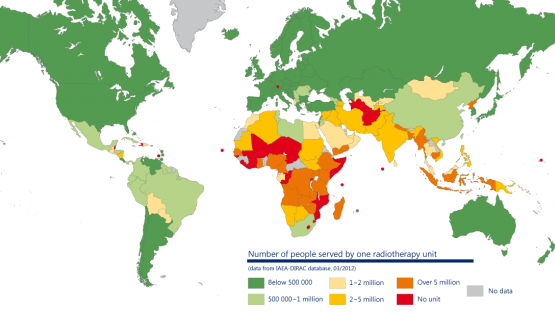
Source: DIRAC, IAEA 2020
And just like how Mitch and his wife had to travel across continents to seek treatment for Chika’s cancer, this scenario is no different for us here in Malaysia, or really South East Asia in general. Long waiting times (think months) in public cancer hospitals often push patients and their families to seek private care for timely treatment. However, the rising costs of cancer – not just for the treatments alone but also post-treatment related care; pose a heavy burden on both cancer patients and their family.
As a Radiation Therapist, experiencing a high workload daily is clinical routine. BUT – knowing that this ‘high number’ in patient flow was only the tip of the iceberg was the breaking point for me. Imagine, like the map above shows, only a SINGLE Radiation Therapy machine is serving 1,000,000 (or more!) people in most of the countries in South East Asia. To put this to perspective, Malaysia has an approximately 31.6mil population (2018 data). Sabah, a large state (73,631 km²) in Malaysia has a 3.54million population (2014 data) and only 3 Radiation Therapy machines in the entire state!
“In 2018, cancer took 9.6 million lives worldwide, with 16,000 lives in Malaysia alone – and every 86 out of every 100,000 males and 102 out of every 100,000 females had cancer.”
Malaysia’s Health director-general Datuk Dr Noor Hisham Abdullah, January 2020
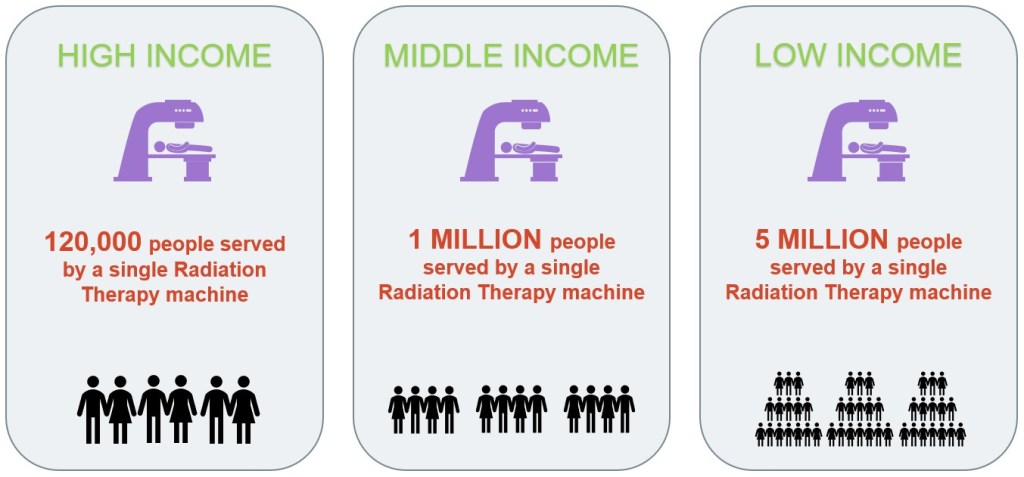
Radiotherapy machines play a vital role in the fight against cancer. However, the stark difference in access to care for some populations is jarring. Just imagine, based on the DIRAC global survey, 1 radiotherapy machine is available for every 120,000 people in high income countries. But in middle income countries, one machine serves over 1 million people. This disparity is exacerbated in low income countries, where ~5 million people rely upon a single radiotherapy machine!
The call for action by Mitch over the ASTRO 2020 Special Session was clear.
“…and as doctors, I implore you to please – look beyond your own backyards, your own cities, your own states and consider we are all part of the family of men and our children, the children of the world. So many children that need this type of treatment (access to cancer care)”
– Mitch Albom at ASTRO 2020
Ultimately, I believe that in order to make a real impact in closing the gap in radiotherapy services, there has to be;
- Trust and partnership amongst governments, international organizations, educational institutions, healthcare providers, radiotherapy vendors, NGOs, and financial institutions
- Understanding the needs of the society from the bottom-up
- Innovation and adoption of digital health technologies that may accelerate the process (i.e. remote treatment planning, remote telehealth consultation assistance from high income countries)
- A consensus among Radiation Therapy healthcare professionals to seize any future opportunity that puts us into a position to advocate for these changes
References:
1. ASTRO 2020 Presidential Symposium & Special Sessions
2. IAEA.org
3. New Straits Times Newspaper, Malaysia
 Stephanie Loo